Sustainable Translation Summit II: Where Language Transforms into Strategy, and Strategy into Results
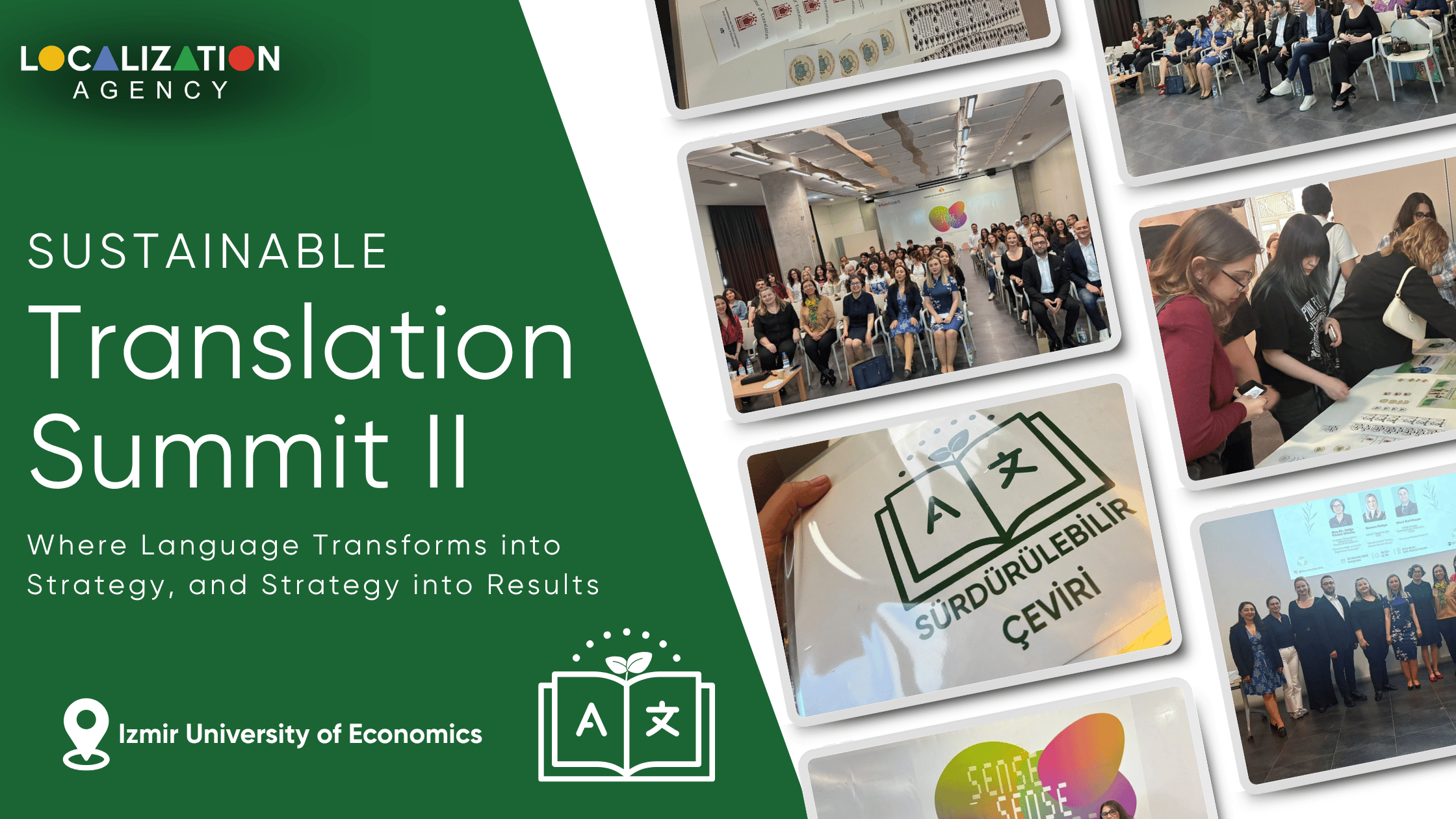
The II. Sustainable Translation Summit, which we hosted on April 30, 2026, at the Izmir University of Economics, went far beyond a traditional academia-industry gathering. It served as a powerful intersection point, demonstrating with concrete examples that language is no longer merely a tool for expression, but directly integrated into decision-making, risk management, and cost control mechanisms.
The audience profile was the clearest indicator of this transformation: Alongside the intense participation of academic, administrative, and student bodies from the Izmir University of Economics, attendees included academicians and students from Dokuz Eylül, Yaşar, Ege, and Manisa Celal Bayar Universities; sustainability agencies; communication teams from energy companies; translators with past experience at NATO, the United Nations, and the Central Bank of the Republic of Türkiye; as well as editors, proofreaders, and terminology experts actively working in the field.
In short, all stakeholders of the translation ecosystem converged on the same sentence. And that sentence was interrupted several times by applause.
This applause was not just for a presentation; it was for the vocalization of a truth we have observed in the field for years, yet which has often remained invisible: Translation is no longer a deliverable; it is a decision-making process.
Why This Summit?
Today, sustainability is not merely the communication language of companies; it is the fundamental determinant of reporting formats, investment strategies, and regulatory compliance. However, the reality we face in the field is as follows:
- The same concept is utilized with different equivalents across different institutions.
- The same report becomes open to multiple interpretations.
- The same data translates into different meanings across different languages.
This situation does not merely create terminological disarray; it directly generates a trust and risk problem.
As we observed in the field studies shared at the summit, even for a single concept, there can be more than one “correct” usage. Yet, in our 25th year in the profession, we know that accurate translation is not about finding the right word; it is about managing the right context.
At the Heart of the Summit: The Sustainable Translation Approach
We have never positioned Sustainable Translation (Sürdürülebilir Çeviri) merely as a dictionary project. This structure is a terminology ecosystem built collaboratively by academia, industry, and language professionals, aiming to make sustainability awareness permanent through language. At the very core of this approach lies quality:
- A term is not merely translated.
- Its context is analyzed.
- Its area of application is evaluated.
- Its regulatory equivalent is examined.
- Its financial impact is anticipated.
It goes far beyond standard word selection; it involves designing precisely where the meaning will land.
The Critical Highlight of the Summit: CBAM
One of the most intensely followed and debated topics at the summit was the European Union’s Carbon Border Adjustment Mechanism (CBAM).
While CBAM may seem like a technical regulation on the surface, it is actually one of the most concrete stress tests for sustainability communication. Because this system forces companies, for the first time, to articulate this sentence: “How much carbon emission did I generate while producing this product?”
However, simply answering this question is not enough; articulating that answer with the correct terms, in the correct format, and within the correct context is now mandatory.
One of the specific applications we underscored at the summit was this: Will you use “Emission,” “Embedded emissions,” or “Verified emissions”? Will “Default values” be applied? Each of these choices represents a different calculation method, a different cost item, and a different regulatory outcome.
Considering that inaccurate or incomplete declarations under CBAM can result in penalties around €80–100 per ton, the mathematical equation is now very simple: A small terminology error = A massive financial risk.
And this represents one of the most distinct breaking points the translation sector has encountered to date.
The Cost of Language: The Reality of the New Era
One of the strongest insights to emerge from the summit was this: In the past, a translation error was a quality problem. Today, it carries: → compliance issues → financial risk → reputational risk. Tomorrow, it will bring all these burdens while simultaneously placing the company at a competitive disadvantage.
This transformation also repositions the translator: A translator no longer:
- merely produces text.
- They manage meaning.
- They anticipate risk.
- They build corporate trust.
We Didn’t Just Speak at the Summit: We Measured, Analyzed, and Recorded
The II. Sustainable Translation Summit also transformed into a live field study. Surveys, term debates, participant insights, interdisciplinary evaluations… These data points formed a critical resource for shaping sustainability terminology based not only on theory but on actual usage.
The Role of Dijital Tercüme: Making the Process Sustainable
As Dijital Tercüme, we focus on establishing a structure that not only initiates this project but ensures its sustainability.
- A continuously updated terminology infrastructure.
- Academia-industry collaborations.
- Regular field research.
- Summits and knowledge-sharing platforms.
Furthermore, we embrace sustainability not only in content but also in our operations; we concretize this approach with projects supporting carbon awareness, afforestation efforts, and environmental contribution models.
Conclusion: The Future Will Be Shaped by Correctly Formulated Sentences
The II. Sustainable Translation Summit demonstrated to us once again: Language is no longer just communication; it is the management of strategy, risk, and outcomes.
In the upcoming period, especially with regulations like CBAM:
- Every company will write a report.
- Every data point will be declared.
- Every statement will be audited.
And the most critical element in this process will be the triad of: “The Right Word. The Right Context. The Right Meaning.”
A sentence is never just a sentence; sometimes it is a cost item, sometimes a risk factor, and sometimes a competitive advantage.
And that is exactly where we step in. As we have for 25 years, we are doing what we know best, in the best way possible.